
If your eyes feel gritty, dry, or tired by mid-afternoon, the problem may not be too few tears.
It may be the oil that keeps those tears from evaporating.
Tiny glands along your eyelids make that oil. When they clog, even a fresh round of artificial tears can seem to wear off within minutes.
Many people keep buying more drops without ever reaching the real cause.
In this post, we will explore 5 ways to support a healthy meibomian gland expression at home, starting with what it is.
Let’s dive in!
What is a Meibomian Gland Expression?
To understand expression, you first have to understand the meibomian glands.
You have dozens of these tiny glands along your upper and lower eyelids, with their openings lined up just behind your lashes.
They produce meibum, a clear oil that spreads over your tears every time you blink.
This oil layer acts like a lid on a pot of boiling water – it slows the watery layer of your tears from evaporating into the air.

When the oil thickens and the glands block up, it leads to a condition called Meibomian Gland Dysfunction (MGD).
Without a healthy oil layer, your tears evaporate quickly, leaving your eyes dry and irritated.
Meibomian Gland Expression is the physical process of clearing out these blockages.
It involves melting the hardened, waxy oils trapped inside the glands and applying gentle pressure to push the stagnant oil out, allowing fresh, fluid oil to flow freely again.
5 Ways to Express Meibomian Glands Safely
These five steps work best together as a daily routine. Start with clean lids and a supported tear film, then add warmth, massage, and a few small habits.
1. Cleanse with Specialized Eyelid Wipes
Before you warm or massage the glands, you need to clear the exit doors.
Makeup residue, flaky skin, bacteria, and old oil love to build up along your lash line, capping the gland openings like a cork.
If you skip this step, warmth and massage leave the oil with nowhere to go.
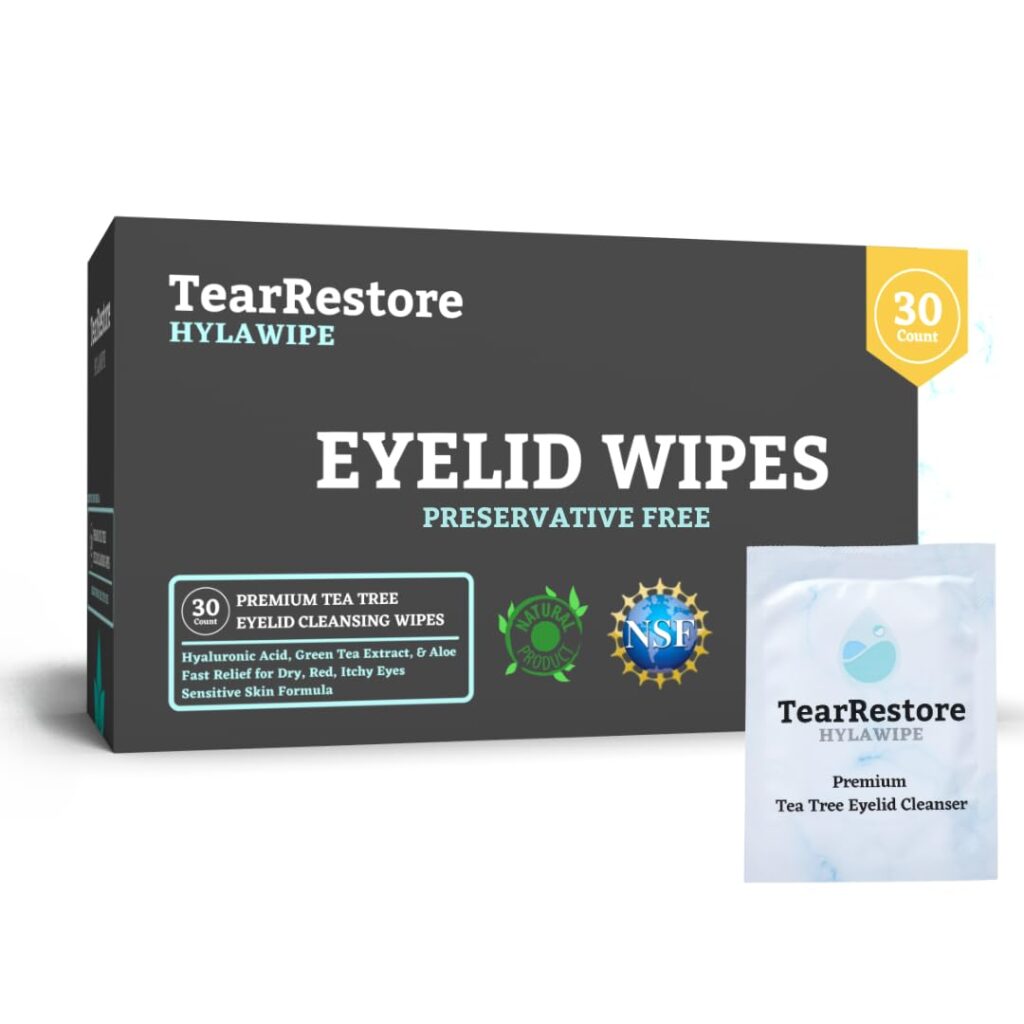
Out of all of the eyelid wipes I’ve tried, these are my personal favorites.
Each wipe combines natural tea tree oil with hyaluronic acid, aloe, and chamomile. The tea tree helps clear debris from the lash line, while the hyaluronic acid, aloe, and chamomile keep sensitive eyelid skin from feeling stripped.
They are hypoallergenic, preservative-free, and rinse-free, and each box holds 30 wipes.
Close your eye and sweep the wipe along the upper lash line from the inner corner out, then the lower lid. Use a fresh side or a new wipe for the other eye. A light tingle is normal – just keep the wipe on the lid, not the eye itself.
Once in the morning and once at night is a great rhythm!
2. Support Your Tear Film with Preservative-Free Eye Drops
When your glands are sluggish, the oil layer on your tears runs thin, and your tears evaporate faster than they should.
Most artificial tears are water-based. They add moisture, but they do nothing for the missing oil, so the relief fades quickly.
That’s why this is my favorite eye drop.
It’s a lipid-based, preservative-free artificial tear made for every type of dry eye, including the evaporative kind linked to MGD.
The formula pairs a lubricant with sodium hyaluronate, castor oil, and DMPC, a phospholipid that supports the oil layer of your tear film.
It uses a nanoemulsion so the oils spread evenly across your eye without the heavy blur many oil-based drops leave behind.
Because it’s preservative-free, there are no preservatives sitting on your eyes with daily use, and the brand says it’s safe for contact lens wearers. It’s designed for once-a-day use, and some people use it twice.
For best results, use it right after cleansing your lids so it spreads over a fresh tear film. Simply follow the directions on the package, and you’re good to go!

3. Use a Warm Compress and Gentle Eyelid Massage
You can’t express a blocked gland while the oil inside is thick and hardened. Warmth softens it, and massage moves it out.
Soak a clean washcloth in warm (not hot) water, test it on your wrist, and hold it over your closed eyes for 5 to 10 minutes. Rewarm it as it cools.
Right after the compress, while the oil is still soft:
- Close your eyes and use a clean fingertip or a cotton swab.
- For your upper eyelids, gently sweep downward from the eyebrow area toward your eyelashes.
- For your lower eyelids, sweep upward from the cheek area toward your eyelashes.
- Work from the inner corner to the outer corner, 5 to 10 sweeps per lid.
Think of it like rolling up a tube of toothpaste – you are gently pushing the softened oils up and out of the tiny glandular channels.
Never press directly into your eyeball; only apply light pressure across the surface of the lids.
4. Practice Blink Training Exercises
We blink far less while staring at screens, and many of those blinks are only partial.
Every time you complete a full, firm blink, the muscles around your eyes naturally squeeze the meibomian glands, releasing a fresh layer of oil.
Every 20 minutes, close your eyes normally, pause for two seconds, gently squeeze your eyelids together for two seconds, and open. Repeat 5 to 10 times.
Pair it with the 20-20-20 rule: every 20 minutes, look at something 20 feet away for 20 seconds.
5. Incorporate Omega-3 Fatty Acids
To help the oil from your glands stay thin and healthy over the long term, support your body from the inside out.
Omega-3 fatty acids from fatty fish, flaxseed, chia, and walnuts, or from a fish or algae oil supplement, may support healthier oil quality over time.
Research on omega-3s for dry eye is mixed, but many eye doctors still recommend them as part of a broader routine. Expect any change to take weeks to months, and check with your doctor before starting a supplement, especially if you take blood thinners.
The Takeaway
Expressing your meibomian glands doesn’t have to be a complicated medical procedure.
A simple daily routine goes a long way:
- Morning: Cleanse your lids with eyelid wipes, then add a preservative-free eye drop.
- Evening: Eyelid wipes, a 5 to 10 minute warm compress, then a gentle lid massage.
- All day: Full blinks every 20 minutes and omega-3s with your meals.
Give it a few weeks. If you notice eye pain, changes in your vision, or a red, swollen eyelid, see an eye doctor, who can offer in-office gland expression or heat treatments.
Thank you for reading, and here is to comfortable, vibrant, and well-hydrated eyes!
Affiliate Disclosure
Some of the links on this site are affiliate links. This means that if you click on the link and purchase the item, we may receive an affiliate commission at no extra cost to you. I only recommend products or services that I believe will add value to my readers, however some (not all) do pay us to be on this blog. Your support and theirs helps keep this blog running, and I genuinely appreciate it.
Medical Disclaimer
The information provided on this website is for educational purposes only and is not intended as medical advice. This blog or the writer is not a licensed healthcare professional, and the content should not be used as a substitute for professional medical diagnosis, treatment, or advice. Always consult with your physician or other qualified healthcare provider before starting any new treatment or making any changes to your healthcare routine.
